We did not set out to build a marketing product. We were running our own paid acquisition — Meta, Google, TikTok, Snapchat, LinkedIn — and every Monday the same thing happened: five dashboards, each reporting in perfect detail that it was doing well, and no way to answer the only question that decides a quarter. Given what every channel returned last month, where does next month's money go?
Nothing on the market answered it. Not because the tools were bad, but because of who they work for. So we built the thing we needed, ran our own spend through it, and eventually admitted it was a product. This post is the reasoning, written down.
Dashboards describe. Nobody prescribes.
The reporting category is enormous and almost entirely rear-view mirror. A dashboard tells you what happened last week, in as much detail as you can stand, and leaves the hard part — deciding what to change — entirely to you.
That gap is not an oversight. Describing the past is safe; prescribing an action means being accountable for it. A chart is never wrong about what it shows. A recommendation can be wrong about what it caused. So the industry settled into a comfortable division of labor: software describes, humans decide, and the deciding happens at 11pm in a spreadsheet assembled by hand from four exports that do not share a schema.
We wanted the second half. Software that reads everything and then says: here is the change, here is why, do you approve?
The alignment problem in ad platform AI
The obvious objection: the platforms already ship optimizers. Meta has Advantage+, Google has Performance Max, and TikTok, Snapchat and LinkedIn each run their own. They are genuinely good. This entire product exists because of what they are structurally unable to do.
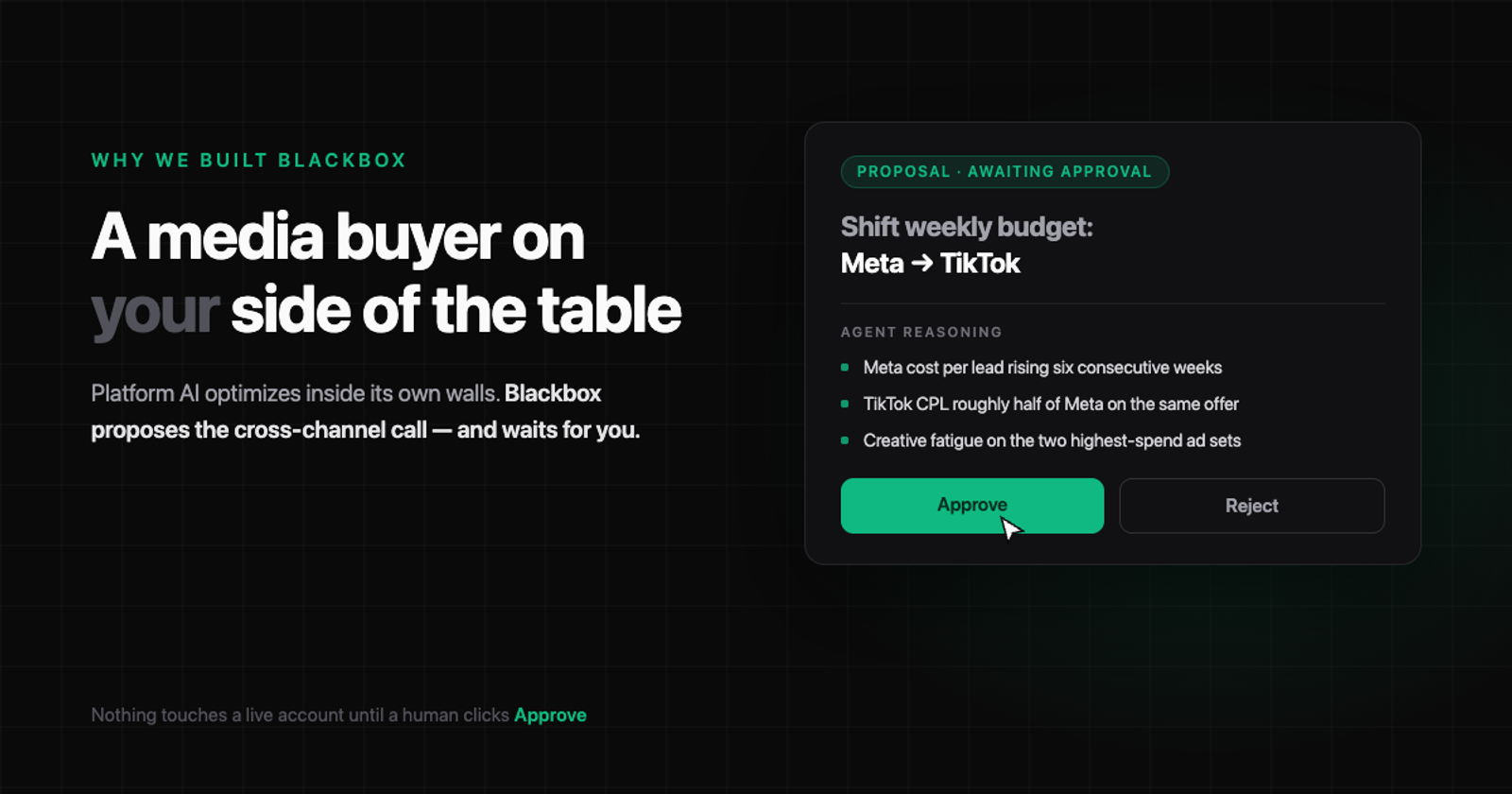
When you ask Advantage+ to optimize your spend, you are asking a system built and paid for by Meta whether Meta is a good place to spend money. It answers honestly — by finding the best available outcome inside Meta. What it will never do is notice that your cost per lead on Meta has drifted up for six straight weeks while TikTok's has halved, and recommend moving a third of the budget across. That is not a missing feature. A recommendation to spend less on Meta is structurally against the interest of the company that built the optimizer. No roadmap fixes that.
So every platform's AI grades its own homework, on its own curve, and the one decision worth more than every bid adjustment underneath it — the cross-channel call — belongs to no system at all. It falls to a person, on feel, because assembling the real comparison takes a morning and goes stale by Thursday.
The fix is not a smarter optimizer. It is an optimizer with a different employer. That is the founding idea of Blackbox: the agent works for the advertiser, sees every channel at once, and is therefore allowed to make the recommendation none of the platforms can.
Proposes, not spends
The second decision mattered as much as the first: Blackbox does not touch a live account on its own. It proposes.
Every recommendation arrives in an inbox with the agent's reasoning attached — what it read, what it noticed, what it wants to change, and why. You approve it or you reject it. Only on approval does anything execute.
We built it that way because we were the first users, and we would not have handed our own accounts to an autonomous system we had just met. It would be strange to expect anyone else to. Trust in this category is not a claim you make on a landing page; it is a history of proposals you can audit — the ones that were right, the ones you rejected, and the reasoning both ways. The approval step is not a training-wheels phase we apologize for. It is the product.
The pattern is worth naming because the rest of the category is conspicuously quiet about it. Tools that recommend without executing leave you the production work. Tools that execute without asking are asking for faith. The interesting position is the third one: full execution, gated by explicit human approval, with the reasoning on the record.
Execution had to be real
A proposal you approve and then implement by hand across three platforms is a to-do list, not automation. So the unglamorous half of Blackbox is that it executes through the real marketing APIs: campaign groups, campaigns, ad sets, creatives, ads and native lead-gen forms, created directly on Meta, Google, TikTok, Snapchat and LinkedIn — with submitted leads pulled back into one view instead of five.
This is the part that took the longest and demos the worst, which is probably why so few tools do it. But it is the difference between advice and work. An agent that cannot ship the campaign it recommended has only moved your job around.
Our own money, first
Blackbox is built by Blackowl, and all of Blackowl's paid acquisition runs through Blackbox. Every proposal pattern the agent uses was tested on our budget before it reached anyone else's. When the agent has a bad idea, we are the first customer it inconveniences.
The second customer was harder to win, and more telling: an established media agency now runs client accounts through Blackbox and shares its management fee for the work the agent does. Agencies are professional skeptics about exactly this kind of software — production work is their margin. We take that arrangement as stronger evidence than any benchmark we could publish.
What Blackbox is, in one paragraph
An AI media buyer that works for the advertiser. It connects your Meta, Google, TikTok, Snapchat and LinkedIn accounts, reads performance across all of them, and proposes changes — budget moves, pauses, new campaigns, creatives — with its reasoning attached. Nothing executes until you approve it. When you do, it does the work through the platforms' real APIs. Fewer tabs, faster decisions, and a buyer whose incentives are yours.
Common questions
Why can't Meta or Google's own AI recommend moving budget to another platform?
Because the recommendation is against the interest of the company that built the optimizer. Advantage+ and Performance Max optimize inside their own platforms, toward their own incentives, and neither can see your results elsewhere. Cross-channel allocation requires an agent that reads every channel and answers to the advertiser.
Does Blackbox spend money autonomously?
No. Every change arrives as a proposal with the agent's reasoning, and nothing touches a live account until a human approves it. On approval, Blackbox executes the change itself through each platform's marketing API.
Which ad platforms does Blackbox work with?
Five: Meta, Google, TikTok, Snapchat and LinkedIn. Connecting an account takes the platform's own OAuth flow — Blackbox reads performance and, once you approve a proposal, creates and edits campaigns through the same APIs the native ad managers use.
If the alignment argument resonates, the deeper version is in AI media buying: who does the agent actually work for? And if you would rather see the inbox than read about it, schedule a demo or start on a self-serve plan.